Research project · 2026
SA-VLA: Spatially-Aware Flow-Matching for Vision-Language-Action Reinforcement Learning
- State Key Laboratory of Information Engineering in Surveying, Mapping and Remote Sensing (LIESMARS), Wuhan University
- Centre for Frontier AI Research (CFAR), Institute of High Performance Computing (IHPC), Agency for Science, Technology and Research (A*STAR)
- Department of Computer Science, National University of Singapore
- Institute of Information Engineering, Chinese Academy of Sciences
- School of Electrical and Electronic Engineering, Nanyang Technological University
* Corresponding author
IEEE/CVF Conference on Computer Vision and Pattern Recognition (CVPR) 2026 Workshop on 3D-LLM/VLA
Abstract
RL fine-tuning can improve the in-distribution performance of flow-matching Vision-Language-Action policies while eroding their spatial generalization under viewpoint and layout shifts. We trace this failure to representation drift, sparse step-level supervision, and spatially unstructured exploration. SA-VLA restores spatial inductive bias by aligning implicit spatial representations, geometry-consistent dense rewards, and SCAN—spatially-conditioned annealed noise—in a shared latent space. Across cluttered manipulation benchmarks, it improves robustness under spatial shifts while maintaining in-distribution performance.
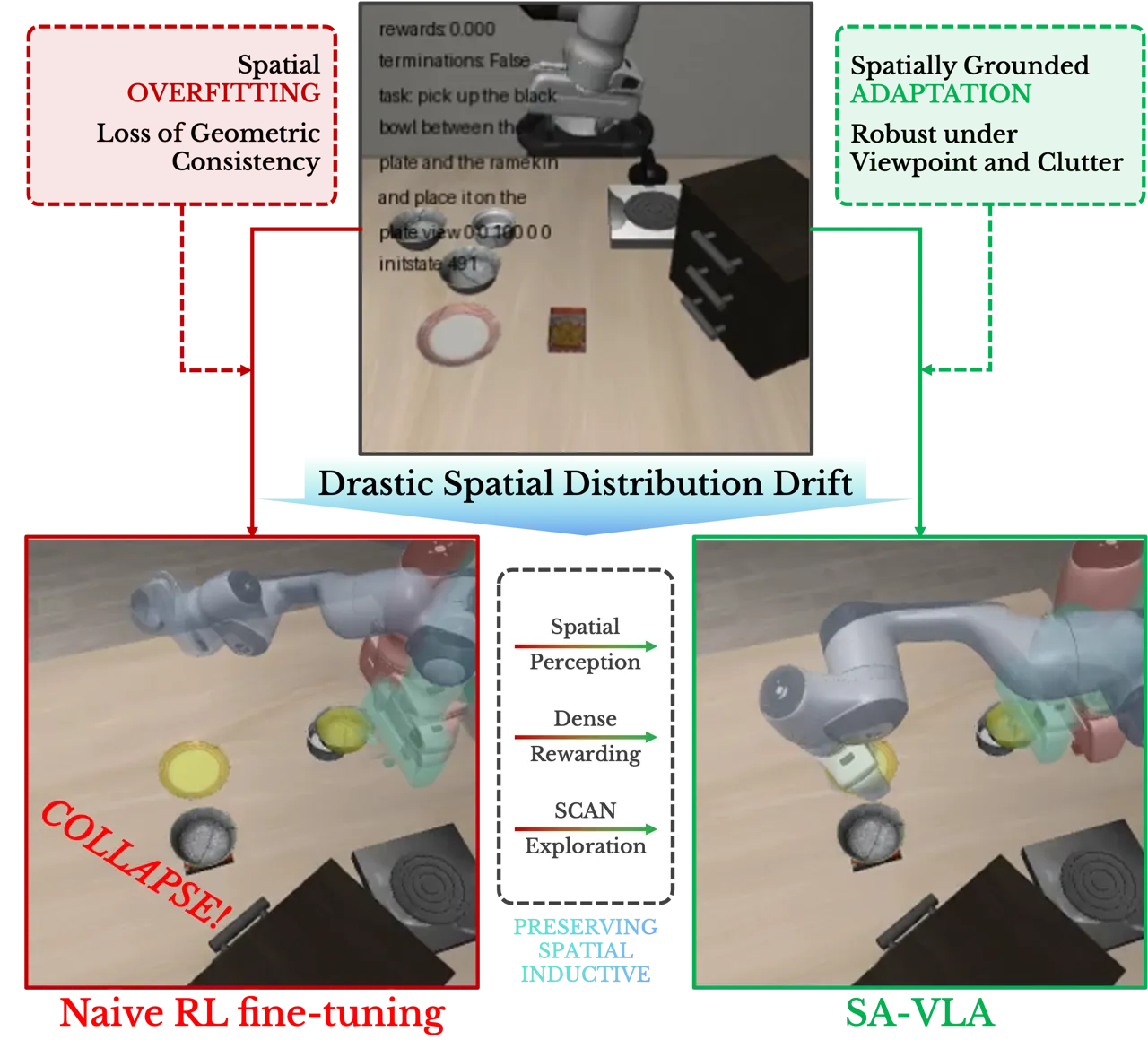
Method
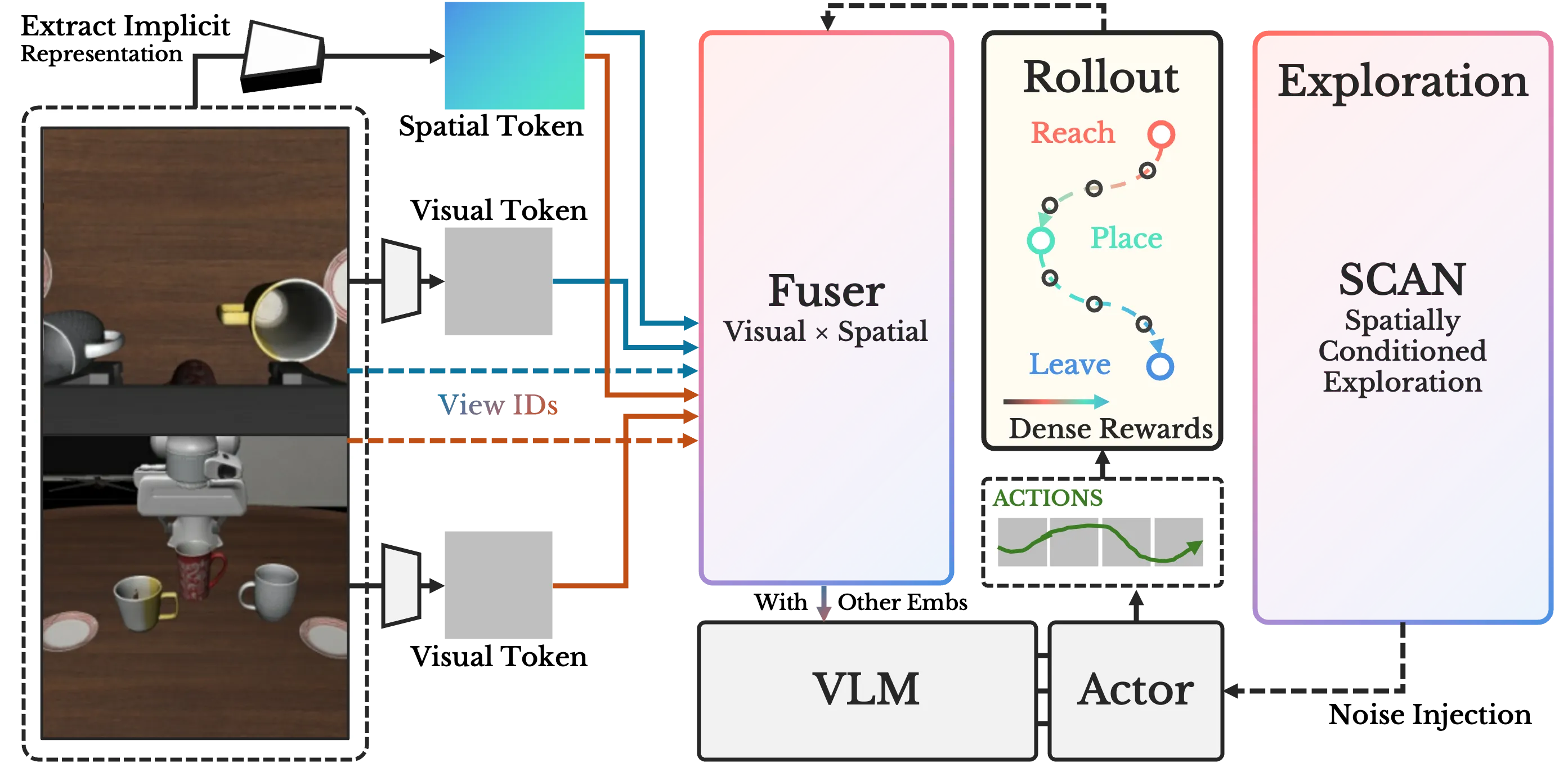
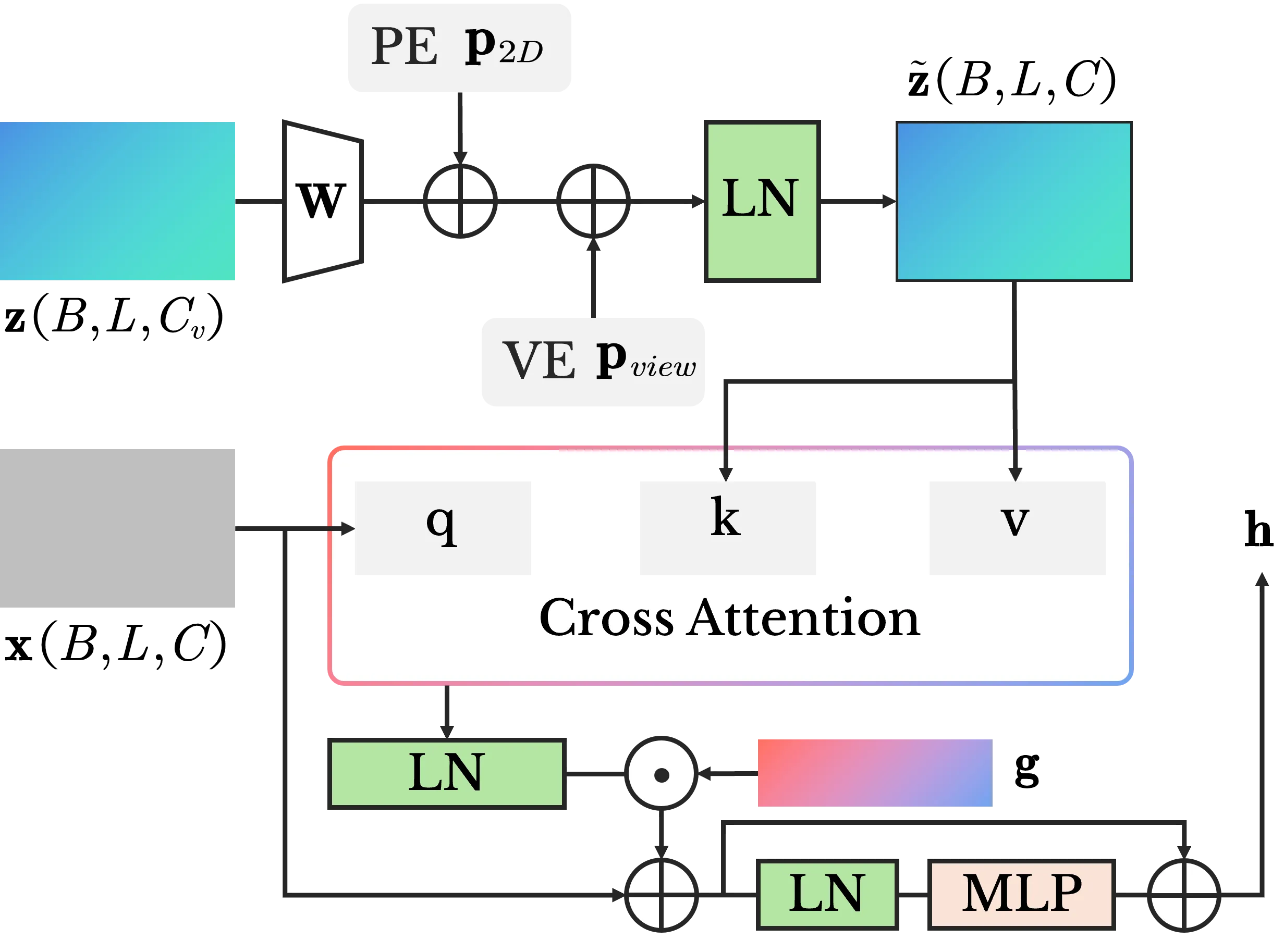
Spatial token fusion
Implicit multi-view spatial tokens are projected into the visual embedding space and fused before the frozen VLM. The asymmetric attention path and gated residual preserve pretrained semantics while adding layout and view cues.
SCAN exploration
SCAN predicts action-noise scale from the geometry-aware latent and maintains an annealed lower bound. It explores uncertain, contact-sensitive states without letting stochasticity collapse during training.
Dense spatial reward
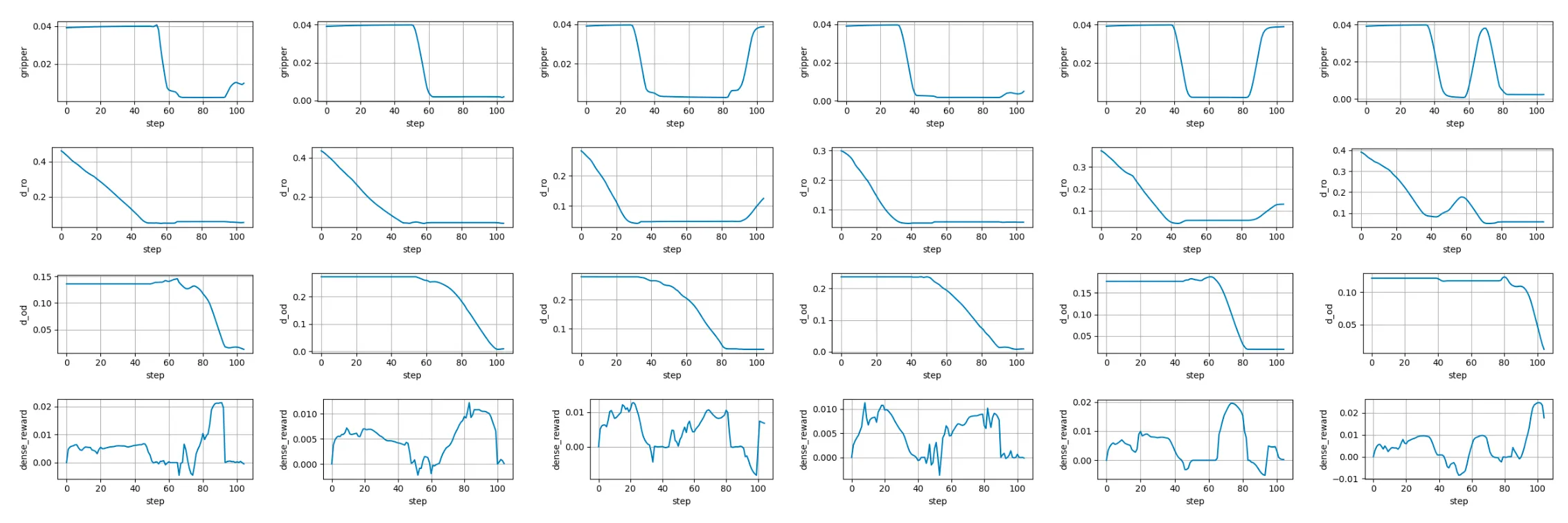
A phase-conditioned reward decomposes manipulation into Approach, Relation–Actuation, and Stabilize. It provides geometric credit assignment from relative distances, contact state, and task progress.
| Instruction example | Family | Goal specification |
|---|---|---|
| Pick the akita black bowl between the plate and ramekin and place it on the plate. | place | place[On](akita_black_bowl_1 → plate_1) |
| Open the middle layer of the drawer. | interact | interact[Open](wooden_cabinet_1_middle_region) |
| Turn on the stove. | interact | interact[TurnOn](flat_stove_1) |
| Turn on the stove and put the moka pot on it. | multi-goal | interact[TurnOn](flat_stove_1); place[On](moka_pot_1 → flat_stove_1_cook_region) |
Evaluation
We evaluate on LIBERO[3] and LIBERO-PLUS[4], with camera-view (CV) and robot-initial-state (RIS) shifts that respectively alter observation geometry and action feasibility. Few-shot adaptation uses three demonstrations per task-shift pair, yielding 60 evaluation configurations. All models are initialized from a $\pi_{0.5}$ flow-matching policy and optimized with PPO; the VLM backbone remains frozen.
| Method | CV | RIS | Total |
|---|---|---|---|
| $\pi_{0.5}$ baseline | 78.47 | 83.77 | 81.00 |
| SA-VLA w/ spatial fusion | 82.30 | 84.29 | 83.25 |
| Method | SCAN | DR | Fusion | SR (%) |
|---|---|---|---|---|
| $\pi_{0.5}$ baseline | – | – | – | 81.00 |
| w/o Fusion | – | ✓ | – | 81.75 |
| w/o DR | – | – | ✓ | 77.50 |
| w/o SCAN | – | ✓ | ✓ | 83.00 |
| SA-VLA | ✓ | ✓ | ✓ | 83.75 |
Results
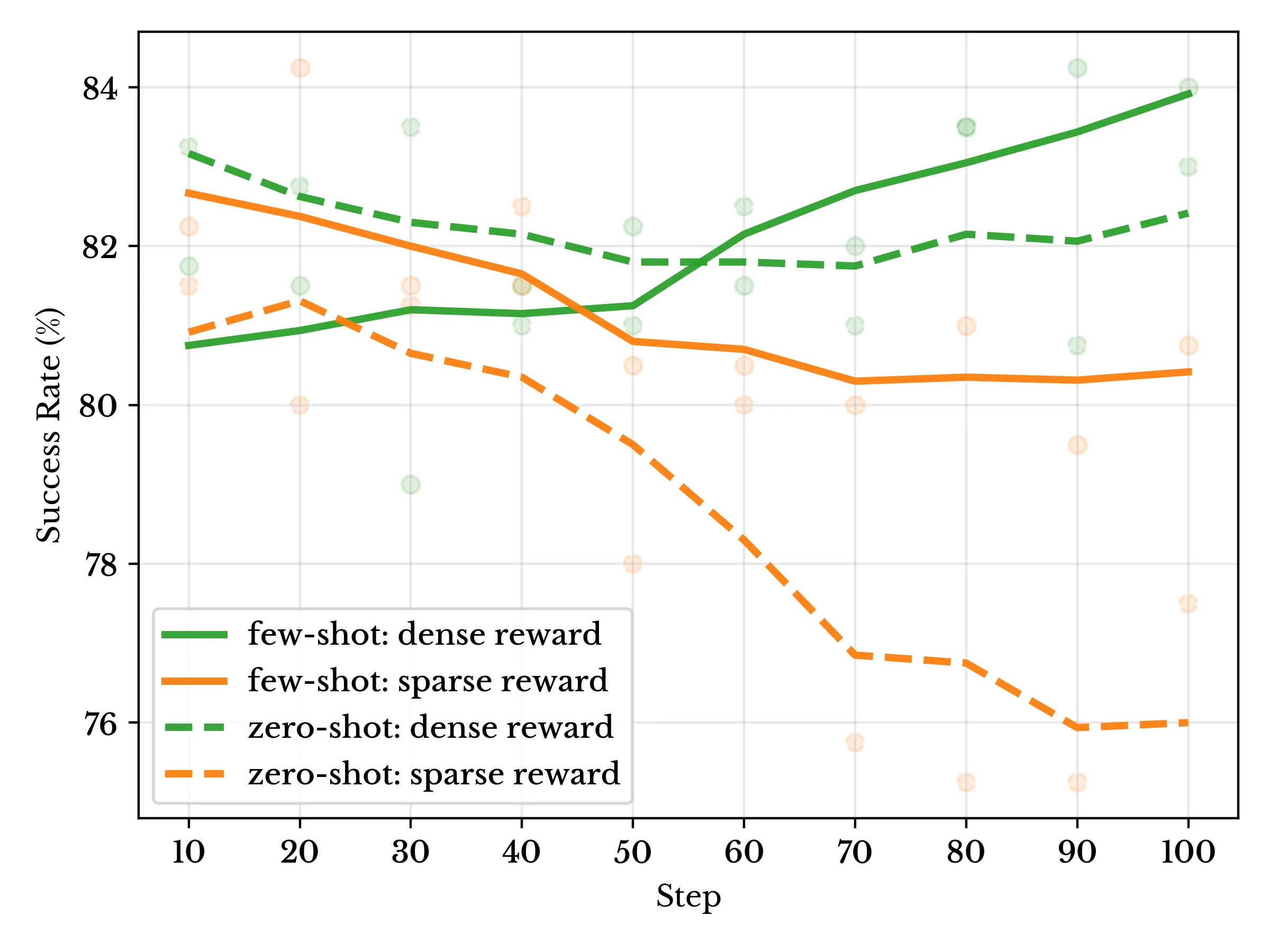
We separate three questions: whether dense feedback stabilizes optimization, whether structured noise improves coverage under sparse data, and whether the resulting policy transfers across heterogeneous perturbations. The sequence below follows that progression.
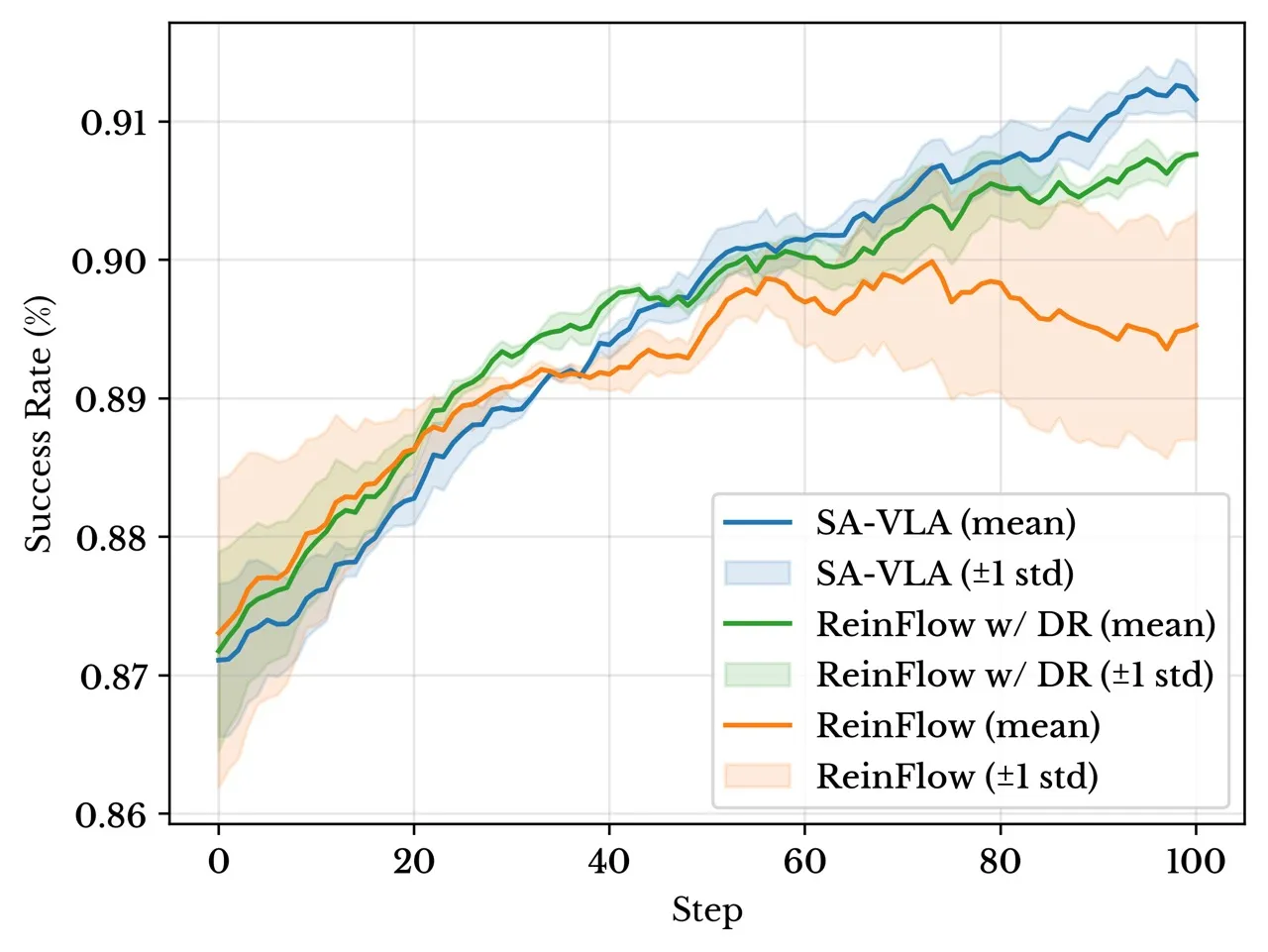
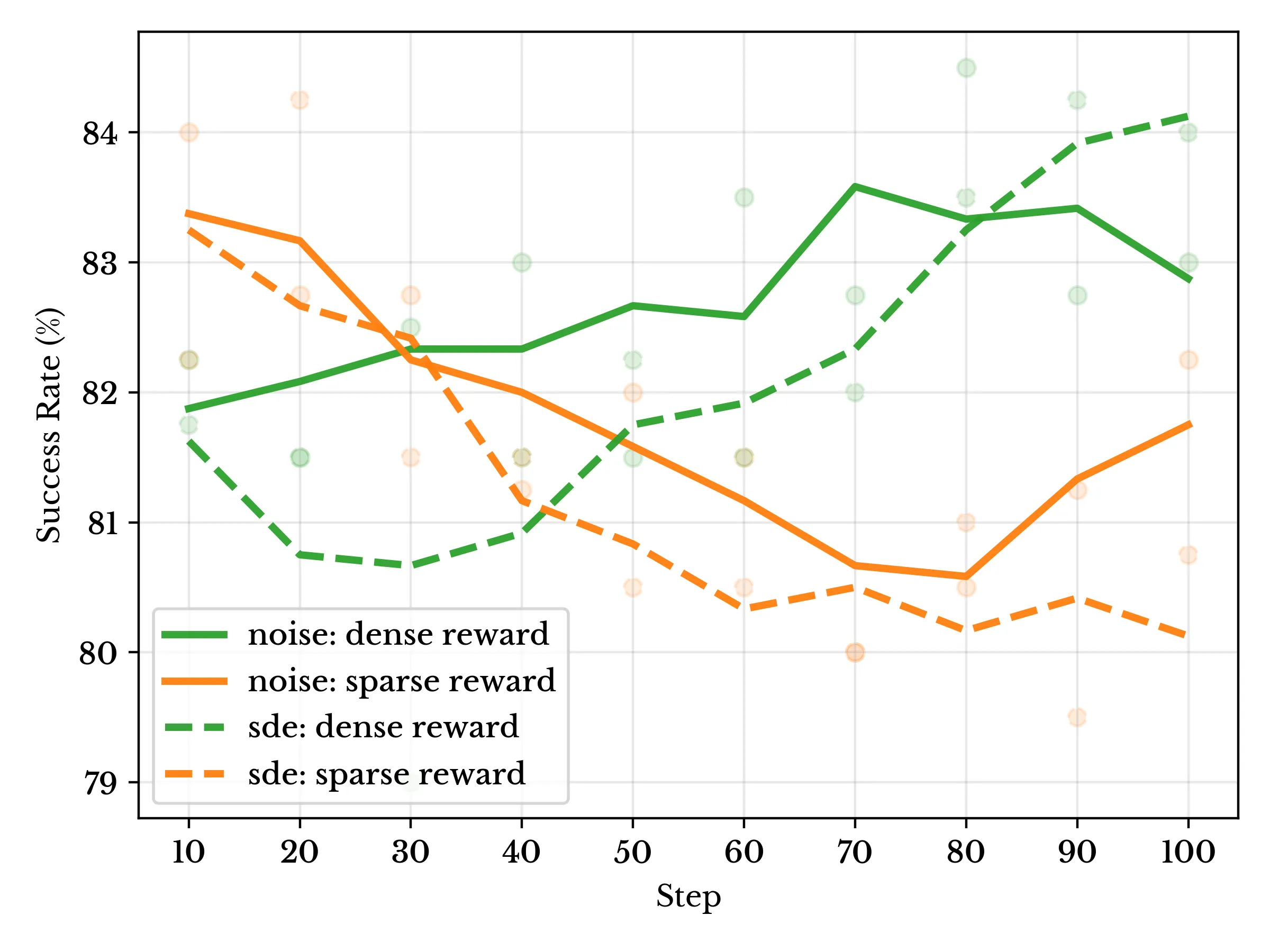
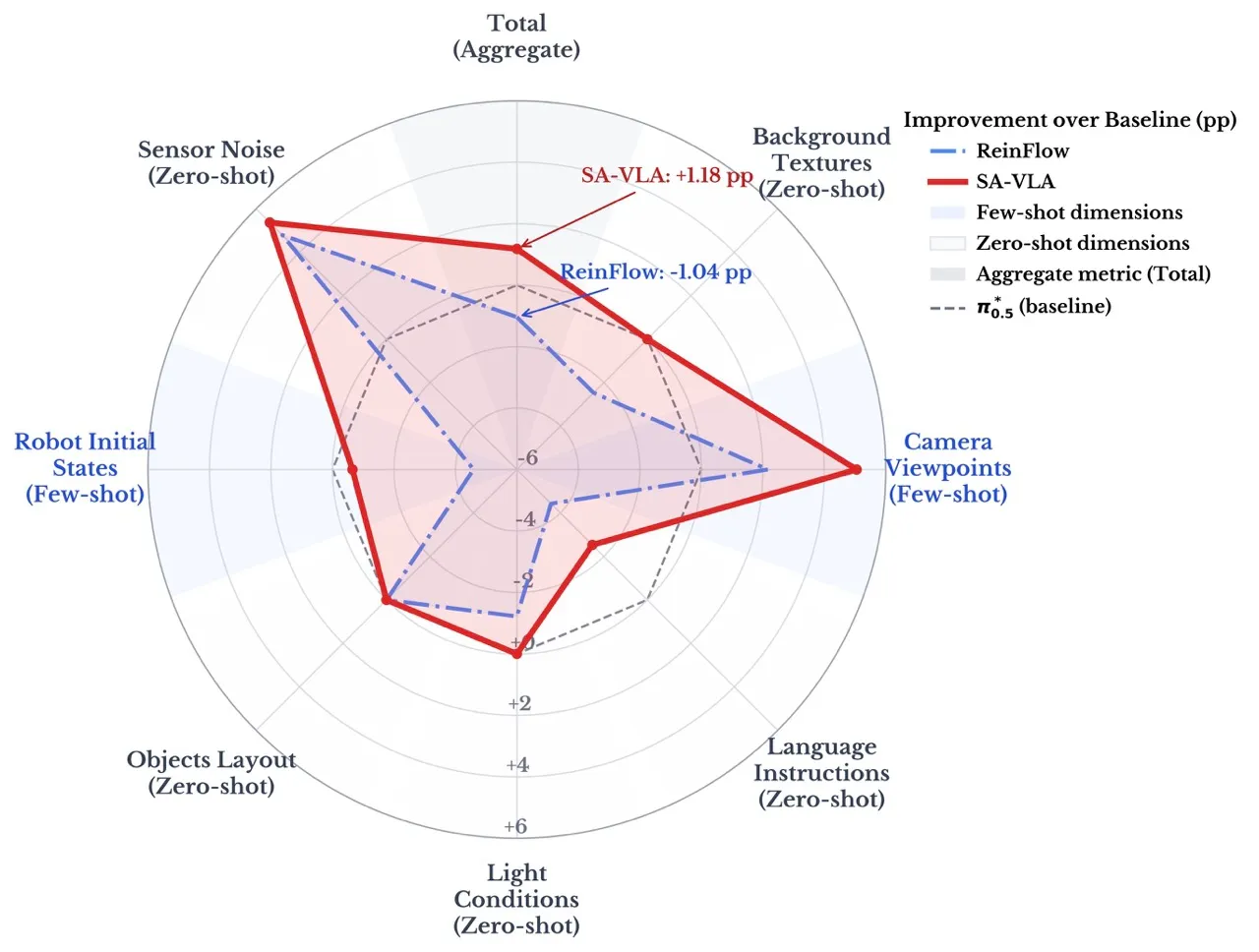
| Methods | Total | BT | CV† | LI | LC | OL | RIS† | SN |
|---|---|---|---|---|---|---|---|---|
| $\pi_{0.5}$ | 88.96 | 100.0 | 82.16 | 88.63 | 98.54 | 100.0 | 83.74 | 87.93 |
| ReinFlow | 87.92 ± 0.81 | 97.53 ± 0.53 | 84.32 ± 0.94 | 84.20 ± 1.45 | 97.32 ± 1.69 | 100.0 ± 0.00 | 79.15 ± 1.58 | 92.72 ± 2.32 |
| SA-VLA | 90.14 ± 0.35 | 100.0 ± 0.00 | 87.21 ± 0.31 | 86.10 ± 1.52 | 98.54 ± 1.26 | 100.0 ± 0.00 | 83.09 ± 0.57 | 93.30 ± 1.85 |
In motion
Citation
@inproceedings{pan2026savla,
  title={SA-VLA: Spatially-Aware Flow-Matching for Vision-Language-Action Reinforcement Learning},
  author={Xu Pan and Zhenglin Wan and Xingrui Yu and Xianwei Zheng and Youkai Ke and Ming Sun and Rui Wang and Ziwei Wang and Ivor Tsang},
  booktitle={IEEE/CVF Conference on Computer Vision and Pattern Recognition Workshops (CVPRW)},
  year={2026},
  url={https://arxiv.org/abs/2602.00743}
}References
- Physical Intelligence, K. Black, N. Brown, et al. “$\pi_{0.5}$: A Vision-Language-Action Model with Open-World Generalization.” arXiv:2504.16054, 2025.arXiv
- T. Zhang, C. Yu, S. Su, and Y. Wang. “ReinFlow: Fine-tuning Flow Matching Policy with Online Reinforcement Learning.” NeurIPS, 2025.arXiv
- B. Liu, Y. Zhu, C. Gao, et al. “LIBERO: Benchmarking Knowledge Transfer for Lifelong Robot Learning.” NeurIPS, 2023.arXiv
- S. Fei, S. Wang, J. Shi, et al. “LIBERO-Plus: In-depth Robustness Analysis of Vision-Language-Action Models.” arXiv:2510.13626, 2025.arXiv