Research project · 2026
SFM: Spatially-Aware Flow Matching for Embodied Reinforcement Learning
- School of Electrical and Electronic Engineering, Nanyang Technological University
- Centre for Frontier AI Research (CFAR), Institute of High Performance Computing (IHPC), Agency for Science, Technology and Research (A*STAR)
- Department of Computer Science, National University of Singapore
- State Key Laboratory of Information Engineering in Surveying, Mapping and Remote Sensing (LIESMARS), Wuhan University
- Institute of Information Engineering, Chinese Academy of Sciences
* Corresponding author
Under Review · 2026
Abstract
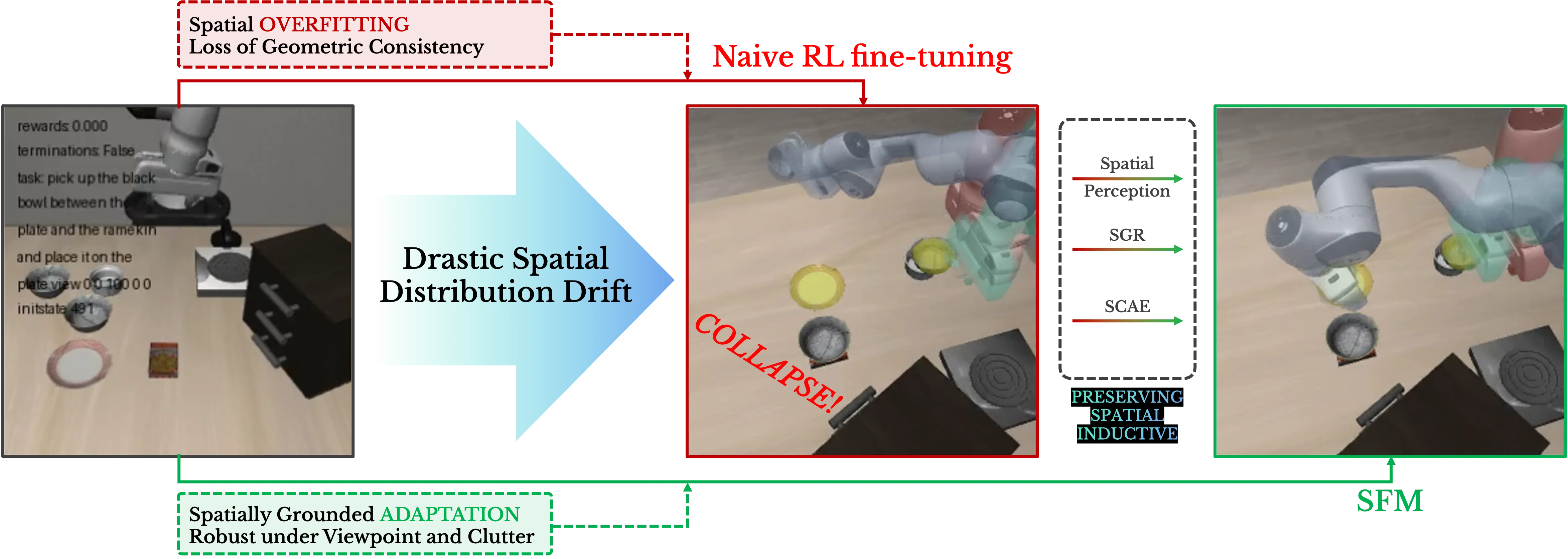
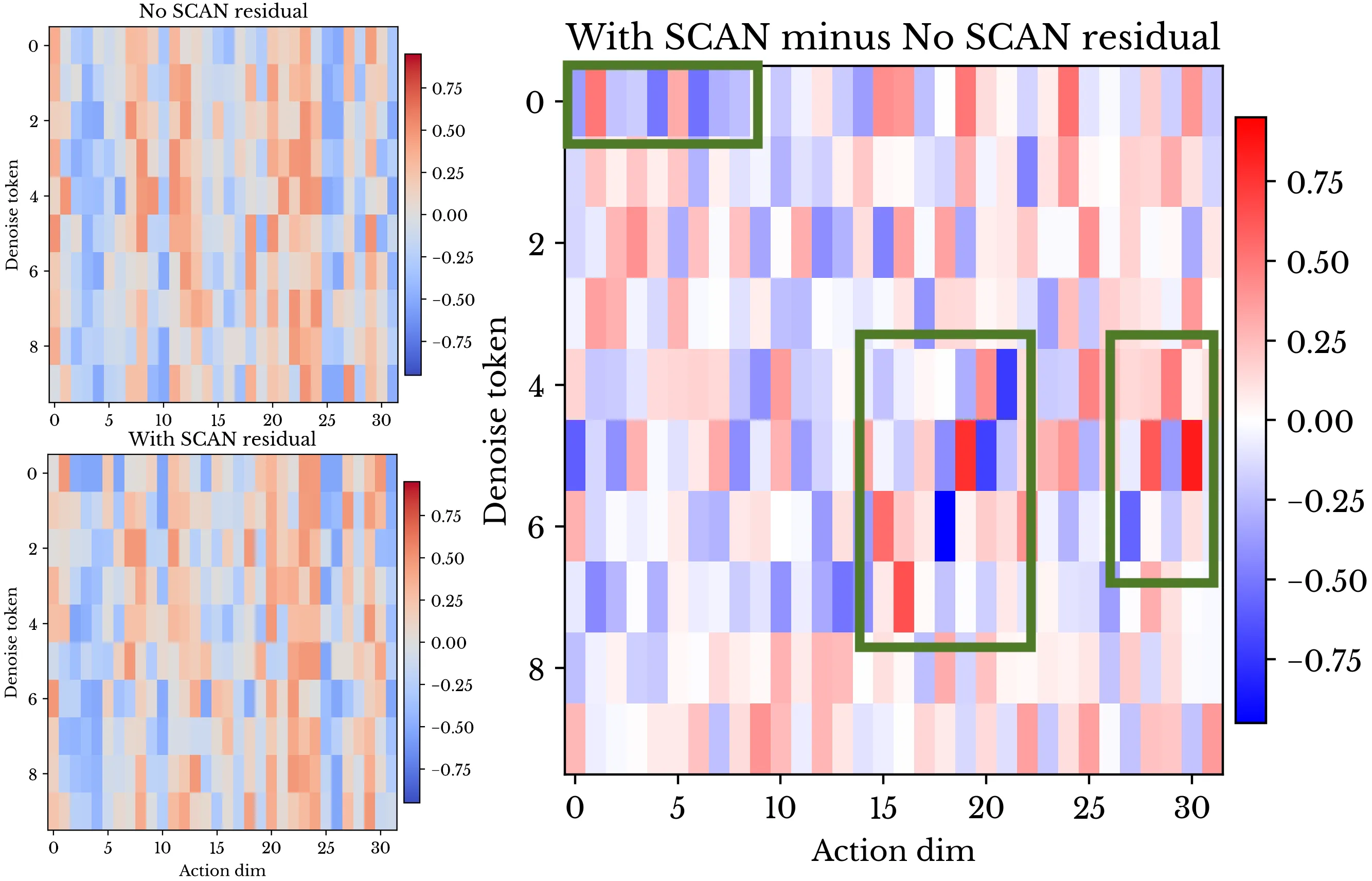
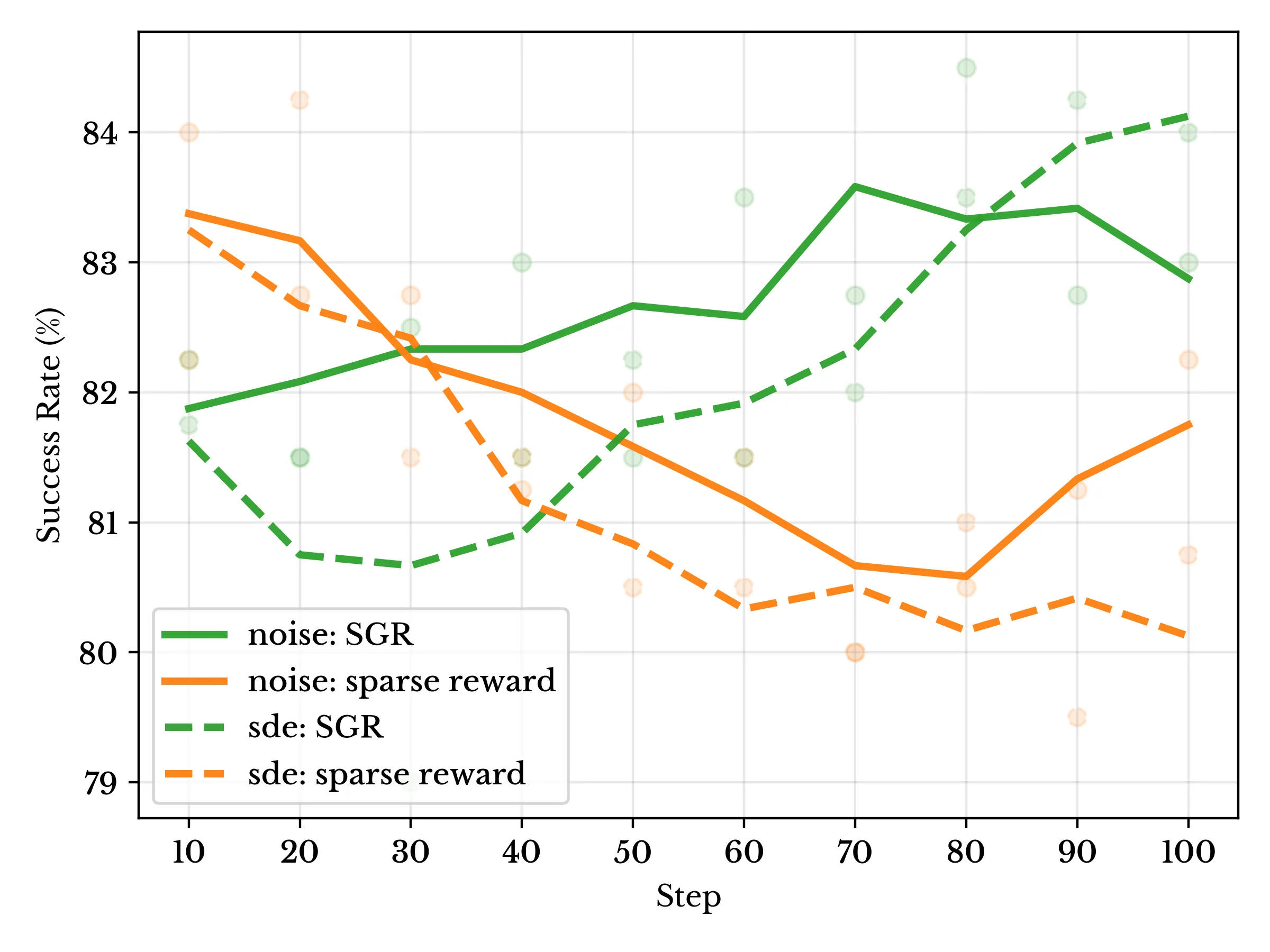
Reinforcement learning can improve a flow-matching Vision-Language-Action policy on its training distribution while making its geometry less reliable under new viewpoints and scene layouts. SFM treats this as a coupled failure of representation, credit assignment, and exploration. It aligns all three in a shared geometric latent space through implicit spatial token fusion, Spatially Grounded Reward (SGR), and Spatially Conditioned Annealed Exploration (SCAE). On LIBERO[3] and LIBERO-Plus[4], this unified design improves robustness to spatial distribution shifts without sacrificing in-distribution control.
Method
Spatial token fusion
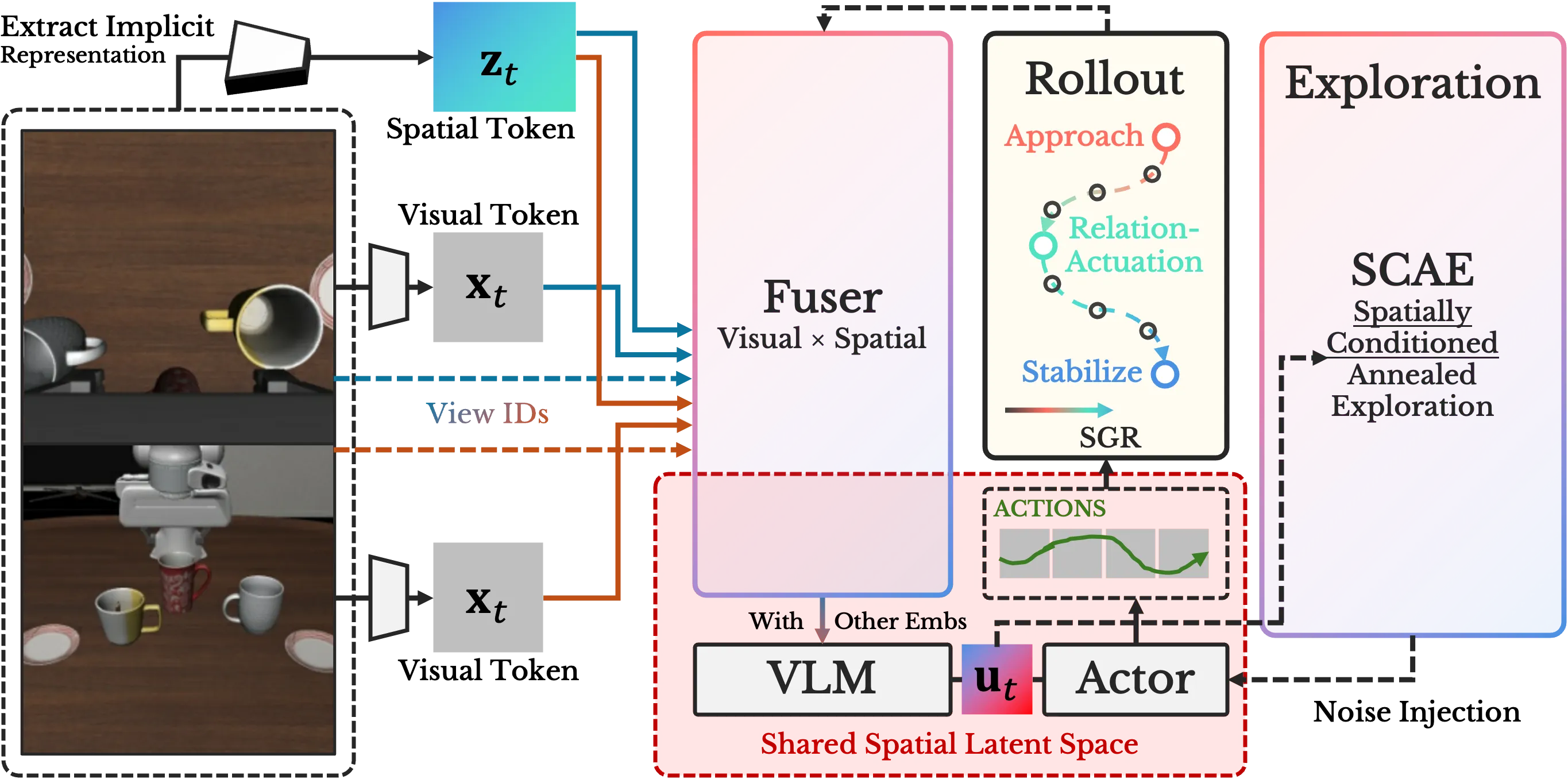
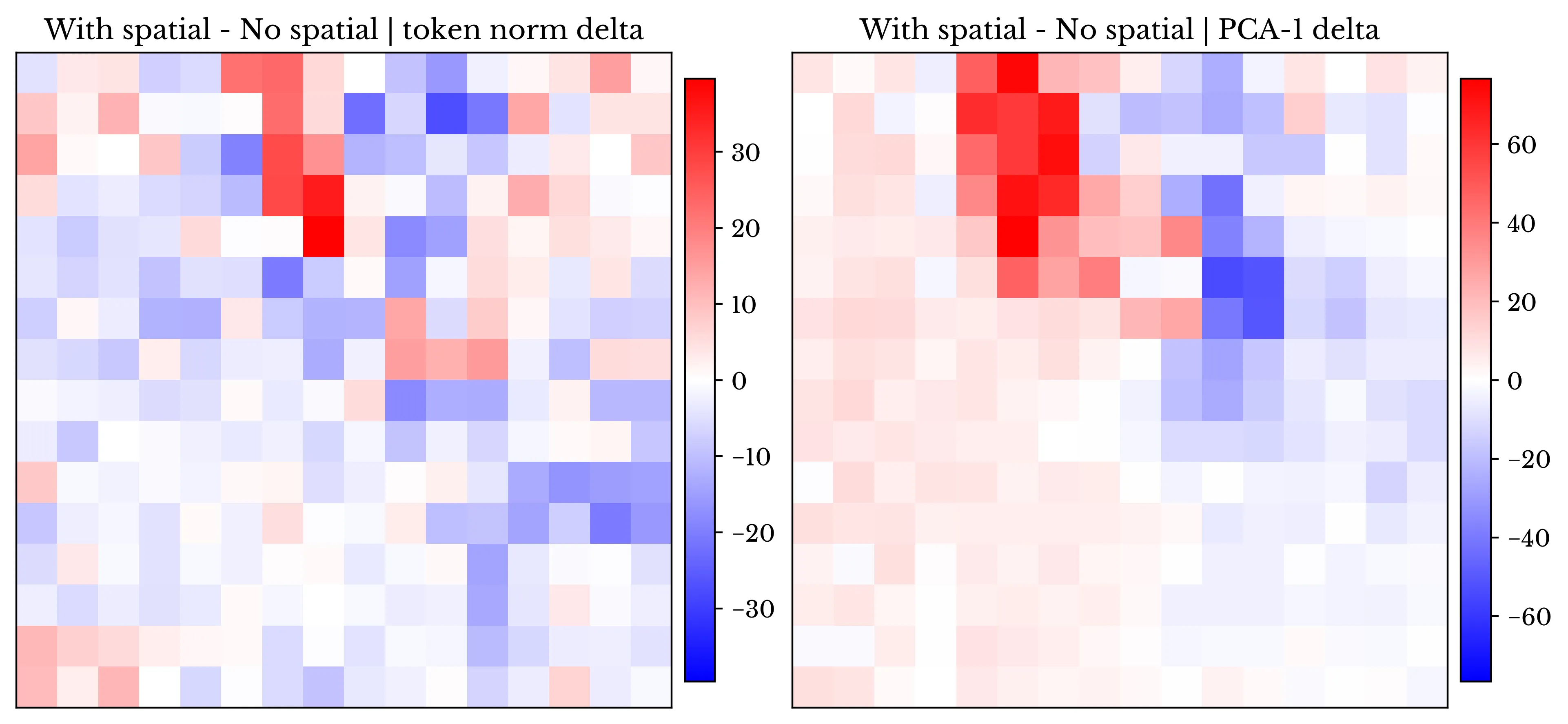
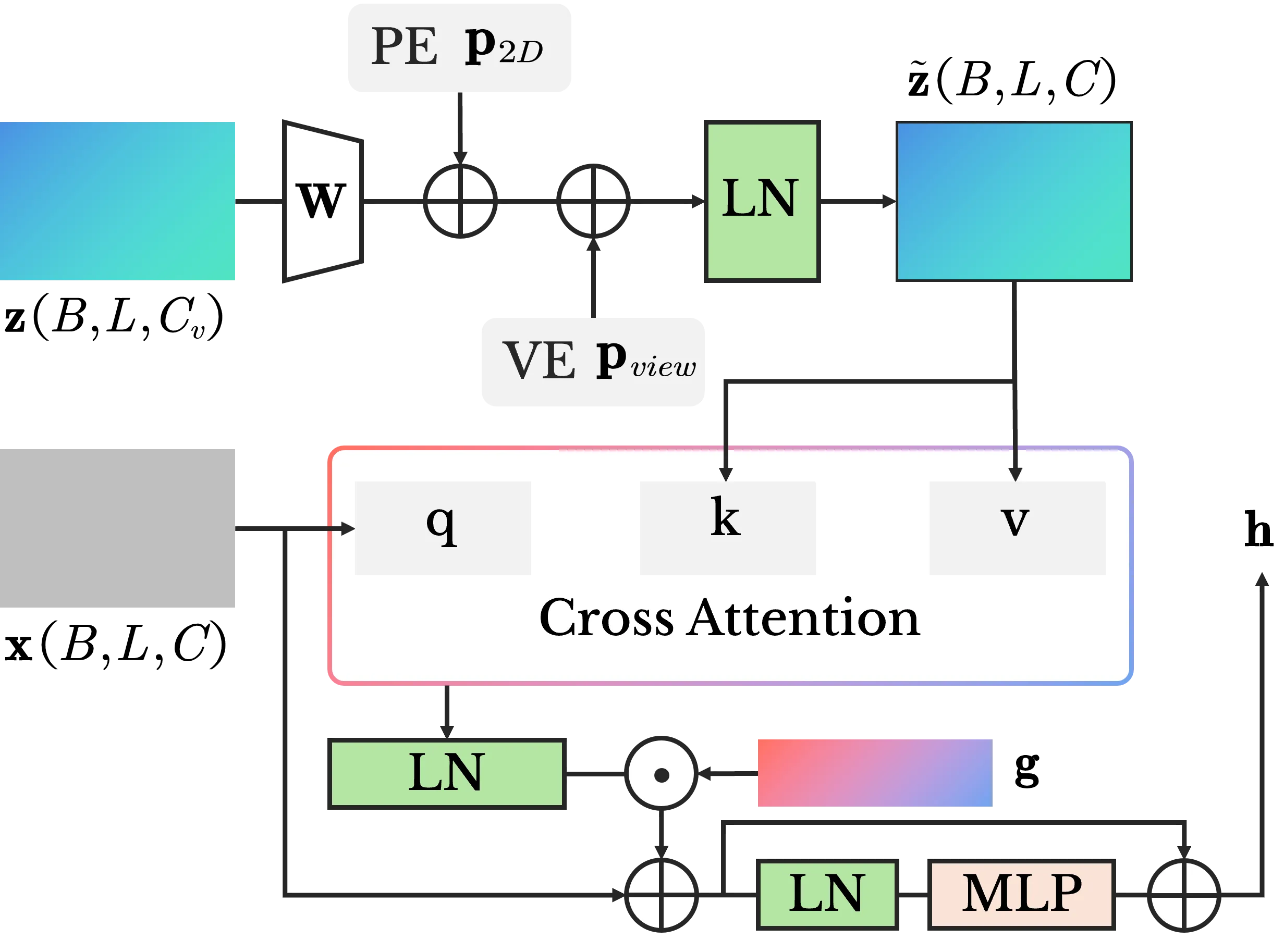
Visual Geometry Grounded Transformer features[1] inject implicit camera and scene geometry into the VLA observation stream through cross-attention.
Grounded reward
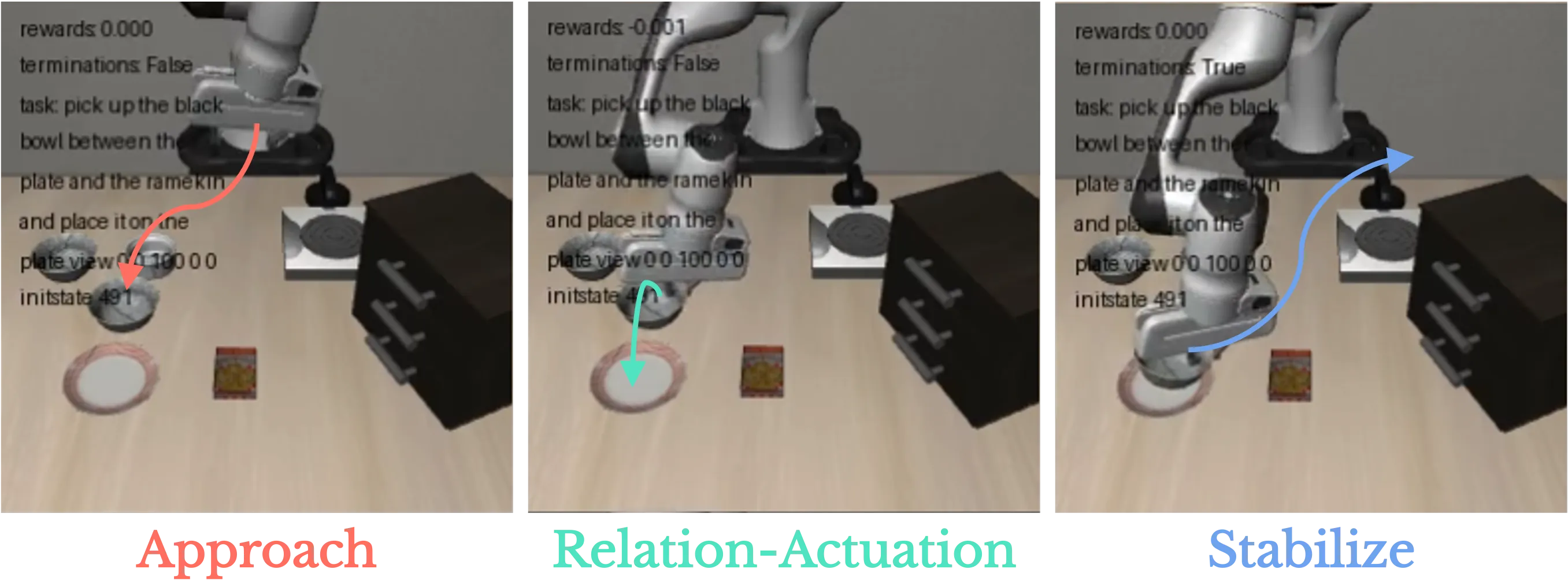
SGR decomposes manipulation into approach, relation–actuation, and stabilization phases, providing dense geometric progress signals beyond sparse task success.
Annealed exploration
SCAE conditions stochastic action perturbations on spatial state and training progress, then anneals them as the policy becomes more certain.


Evaluation
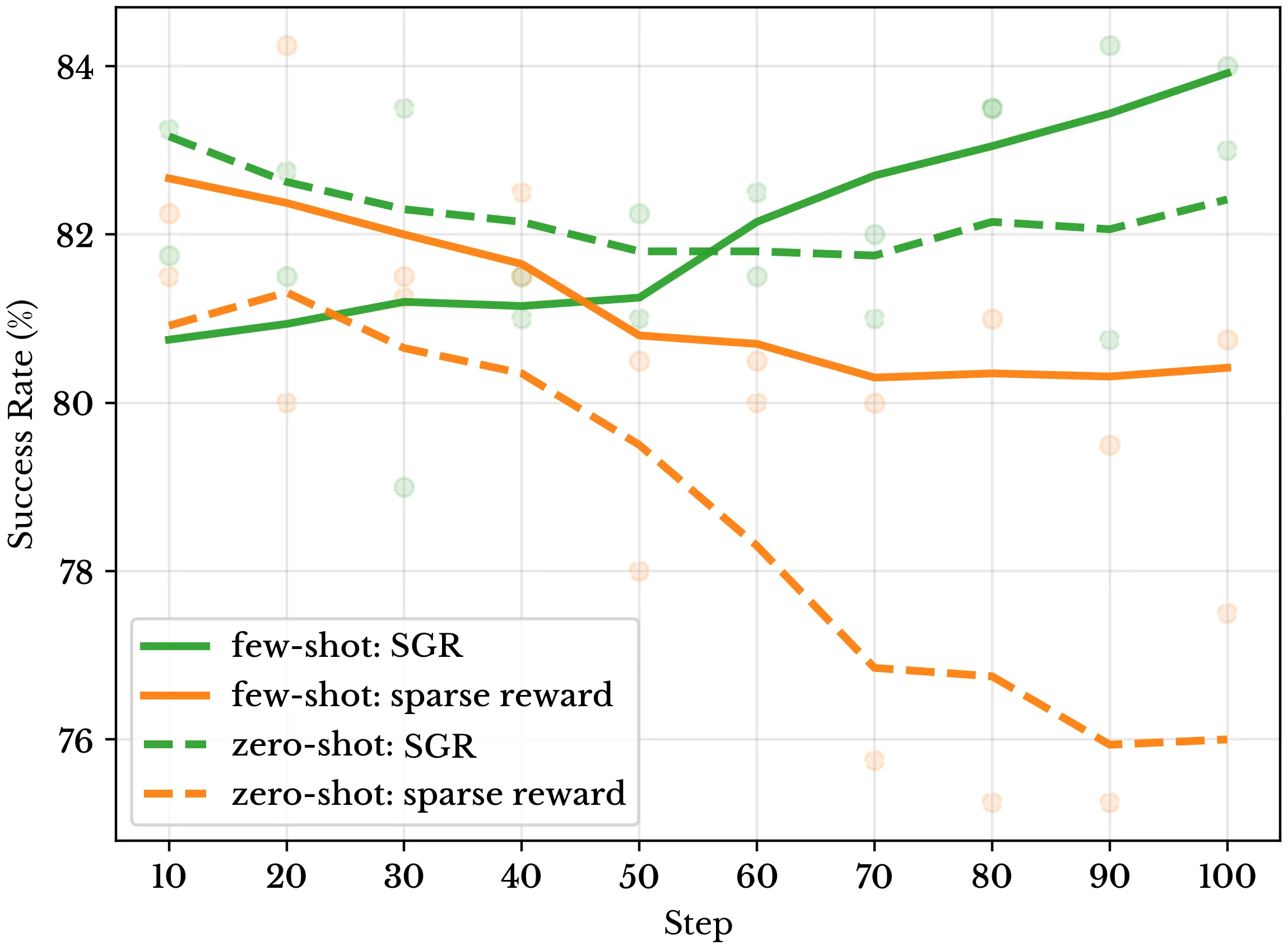
SFM initializes from the frozen 7B SigLIP–Gemma backbone of π0.5[2] and is optimized with PPO and GAE in RLinf-VLA[7]. Training uses 64 parallel environments, batches of 1,024 transitions, and a 240-step episode horizon. The spatial robustness suite covers few-shot camera-view (CV) and robot-initial-state (RIS) shifts, plus zero-shot background texture, lighting, layout, object-location, and sensor-noise shifts.
| Method | CV | RIS | Total |
|---|---|---|---|
| π0.5 | 78.47 | 83.77 | 81.00 |
| SFM w/ spatial fusion | 82.30 | 84.29 | 83.25 |
Results
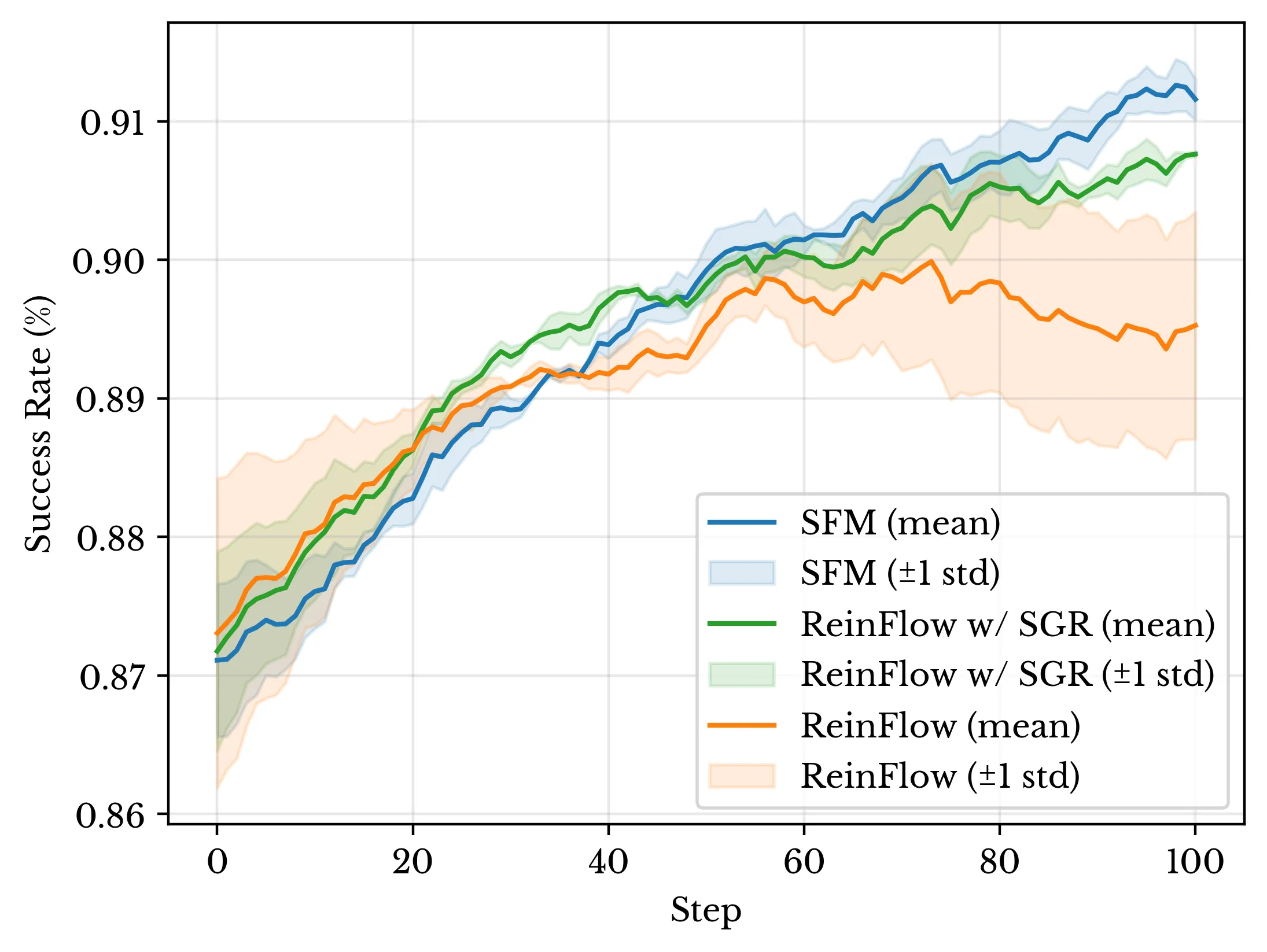
The complete system reaches 90.14% aggregate robustness, outperforming both ReinFlow[5] and Flow-GRPO[6]. Its clearest gain appears under camera-view perturbation, where success rises to 87.21%. Ablations show that the three components are complementary: removing SGR is especially damaging, while spatial fusion and SCAE each add robustness beyond dense reward alone.
| Method | Total | BT | CV | LI | LC | OL | RIS | SN |
|---|---|---|---|---|---|---|---|---|
| π0.5 | 88.96 | 100.00 | 82.16 | 88.63 | 98.54 | 100.00 | 83.74 | 87.93 |
| ReinFlow | 87.92±0.81 | 97.53±0.53 | 84.32±0.94 | 84.20±1.45 | 97.32±1.69 | 100.00±0.00 | 79.15±1.58 | 92.72±2.32 |
| Flow-GRPO | 89.29±0.46 | 99.07±0.93 | 85.23±1.13 | 87.20±0.47 | 97.81±0.73 | 100.00±0.00 | 81.12±0.28 | 92.53±1.72 |
| SFM | 90.14±0.35 | 100.00±0.00 | 87.21±0.31 | 86.10±1.52 | 98.54±1.26 | 100.00±0.00 | 83.09±0.57 | 93.30±1.85 |
| Variant | SCAE | SGR | Fusion | Total |
|---|---|---|---|---|
| π0.5 | — | — | — | 81.00 |
| w/o fusion | — | ✓ | — | 81.75 |
| w/o SGR | — | — | ✓ | 77.50 |
| w/o SCAE | — | ✓ | ✓ | 83.00 |
| SFM | ✓ | ✓ | ✓ | 83.75 |

Citation
@misc{pan2026sfm,
  title={SFM: Spatially-Aware Flow Matching for Embodied Reinforcement Learning},
  author={Xu Pan and Zhenglin Wan and Xingrui Yu and Xianwei Zheng and Youkai Ke and Ming Sun and Rui Wang and Ziwei Wang and Ivor Tsang},
  year={2026},
  note={Under review}
}References
- J. Wang, M. Chen, N. Karaev, et al. “VGGT: Visual Geometry Grounded Transformer.” CVPR, 2025.arXiv
- Physical Intelligence, K. Black, N. Brown, et al. “π0.5: a Vision-Language-Action Model with Open-World Generalization.” 2025.arXiv
- B. Liu, Y. Zhu, C. Gao, et al. “LIBERO: Benchmarking Knowledge Transfer for Lifelong Robot Learning.” NeurIPS, 2023.arXiv
- S. Fei, S. Wang, J. Shi, et al. “LIBERO-Plus: In-depth Robustness Analysis of Vision-Language-Action Models.” 2025.arXiv
- T. Zhang, C. Yu, S. Su, and Y. Wang. “ReinFlow: Fine-tuning Flow Matching Policy with Online Reinforcement Learning.” 2025.arXiv
- J. Liu, G. Liu, J. Liang, et al. “Flow-GRPO: Training Flow Matching Models via Online RL.” 2025.arXiv
- H. Zang, M. Wei, S. Xu, et al. “RLinf-VLA: A Unified and Efficient Framework for VLA + RL Training.” 2025.arXiv